Guadalajara or Puerto Vallarta: Which Jalisco Base Fits Your Trip
Published Jul 3, 2026 · updated Aug 29, 2026
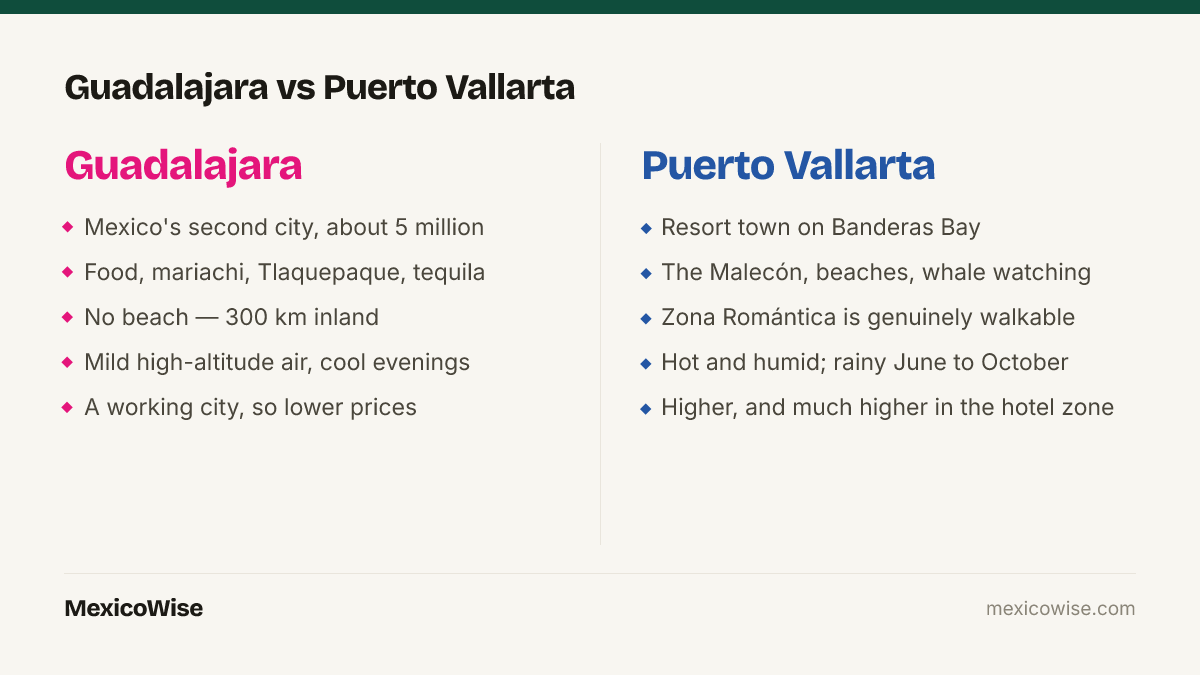
The honest answer up front: base in Guadalajara if you are here for food, music and city life, and Puerto Vallarta if you mostly want to be near the water. Both are in Jalisco, and travelers keep assuming that means they are close. They are not a day trip from each other. The drive is roughly four to five hours through the Sierra Madre, approximate, so treat them as two separate bases, not a hub and a spoke. Here is how to actually choose, and how to do both if you have the days.
| Guadalajara | Puerto Vallarta | |
|---|---|---|
| What it is | Mexico’s second city, about 5 million people | Resort town on Banderas Bay |
| Airport | GDL — large, well connected | PVR — heavy international leisure traffic |
| The draw | Food, mariachi, Tlaquepaque, tequila country | The bay, the Malecón, whale watching, beaches |
| Beach | None. Two hundred miles inland. | The whole point |
| Walkability | By neighborhood; you’ll use Uber between them | Zona Romántica and Centro are genuinely walkable |
| Weather | Mild, high-altitude, cool evenings | Hot and humid; rainy Jun–Oct |
| Cost | Lower — a working city | Higher, and much higher in the hotel zone |
| Best for | Food, culture, day trips to Tequila and Lake Chapala | Beaches, bay activities, an easy first Mexico trip |
Guadalajara if you want the city
Guadalajara is a real Mexican metropolis of about five million people, not a resort built for you. That is the whole appeal. Mariachi genuinely started in this region, tequila country is an hour west, and the neighborhoods reward walking rather than shuttle vans.
Where to stay and what it is like
Base yourself in Colonia Americana or the Lafayette pocket beside it. Avenida Chapultepec runs through the middle with cafes, mezcalerías and a Sunday market, and it is a short ride to the Centro Histórico with its twin-spired Catedral, the Teatro Degollado, and the Instituto Cultural Cabañas, where you stand under José Clemente Orozco’s Man of Fire murals. Mercado San Juan de Dios near the center is one of the largest indoor markets in Latin America. On the eastern edge of the city, Tlaquepaque and Tonalá are where you buy actual crafts, blown glass and ceramics, instead of airport souvenirs, and Tlaquepaque’s pedestrian streets are worth an afternoon on their own.
The food
This is Guadalajara’s knockout argument. Torta ahogada (a crusty birote roll drowned in tomato and árbol-chile salsa), birria (goat or beef stew, and yes, the birria the world copied), and carne en su jugo are all Guadalajara plates first. Wash it down with tejuino, a cold fermented-corn drink sold from carts. Tequila proper is an hour away in the town of Tequila, where you can tour the José Cuervo and Sauza distilleries or ride the tourist train out through the agave fields.
The downsides are honest: it is hotter and drier than the coast, landlocked, and the traffic is genuine big-city traffic. But your money stretches further here than in any beach town in the country.
Puerto Vallarta if you want the bay
Puerto Vallarta is the beach base, sitting on Bahía de Banderas. The part that matters is the Zona Romántica, also called Old Town or the Colonia Emiliano Zapata, south of the Río Cuale.
Where to stay and what it is like
Stay in the Zona Romántica and everything is walkable: Playa Los Muertos and its striped pier, the best concentration of restaurants, and the heart of one of the most welcoming LGBTQ+ scenes in Mexico. The Malecón boardwalk runs the waterfront north from there past bronze sculptures to the Centro. The catch: the hotel zone and Marina Vallarta to the north are the generic, big-resort part of town, and Nuevo Vallarta across the bay is actually in Nayarit. Stay in Old Town and you skip most of the beige.
The bay is the point
Vallarta’s real trick is the water. From the Los Muertos pier or from Boca de Tomatlán just south, boats run to the roadless south-shore villages: Yelapa with its waterfall and beach palapas, Las Ánimas, and Quimixto. You cannot drive to these; the boat ride is the access. Food leans to the sea here, especially pescado zarandeado (whole fish butterflied and grilled over wood) and fresh ceviche. Sayulita, the surf town, is about an hour north if you want a day trip.
The downsides: it costs more than Guadalajara, summer humidity is heavy from June into October, and the resort strip can feel packaged if you stay in the wrong zone.
Getting between them
Do not try to make one a base and the other a day trip. The mountain road, via Mascota, eats the whole day and delivers you carsick. Your options if you want both:
- Fly. The GDL-to-PVR hop is about 50 minutes on Volaris, VivaAerobus or Aeroméxico, frequent and often cheaper than travelers guess.
- Bus. ETN and Primera Plus both run comfortable coaches between Guadalajara and Puerto Vallarta in roughly five to six hours, approximate. ETN’s reclining seats make the mountain route bearable if you would rather not fly.
- Drive only if the road itself is the plan and you are stopping in the Sierra towns.
If you have a week or more, the clean split is three or four nights in Guadalajara first, then the short flight west to finish on the bay.
Quick call by use case
- Food, music, mezcal and value: Guadalajara, no contest.
- Beach, bay, boat-only villages and a walkable seaside old town: Puerto Vallarta.
- First trip to Mexico and you want everything easy and English-friendly: Puerto Vallarta.
- You have traveled Mexico before and want the real, unpolished city: Guadalajara.
- Traveling as an LGBTQ+ couple who want a welcoming beach base: Puerto Vallarta’s Zona Romántica.
- Crafts, day trips and tequila country: Guadalajara, with Tlaquepaque and the town of Tequila within reach.
The bottom line
Both are safe to base in with normal city awareness, so let the choice come down to what you will actually be doing at 6 p.m. every evening. If that is a mezcalería in Colonia Americana and birria the next morning, it is Guadalajara. If it is a beer on the sand at Los Muertos watching the boats come back from Yelapa, it is Puerto Vallarta. Dig deeper into each on the Guadalajara and Puerto Vallarta pages, or see how they fit the rest of the state on the Jalisco hub.
More from Jalisco