Baja California vs. Baja California Sur: Two Very Different Trips
Published Jul 3, 2026 · updated Aug 29, 2026
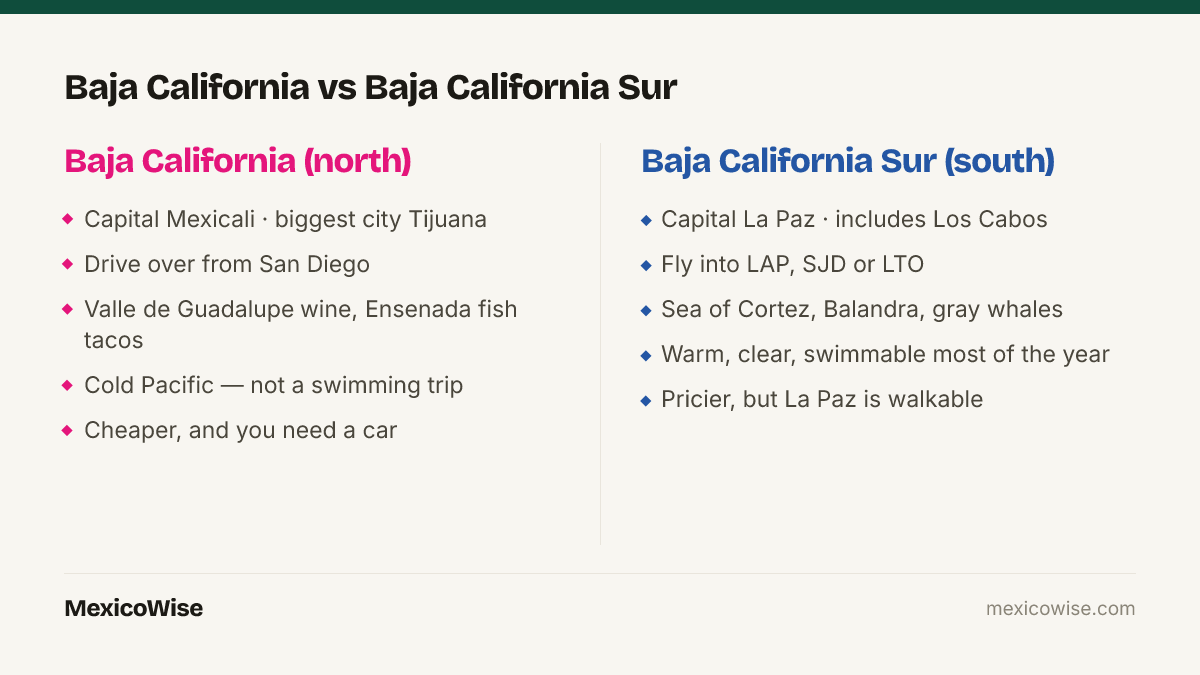
Go north for wine and food, south for water and whales — and do not try to do both in one week. Baja California and Baja California Sur are two separate states sharing one 1,200 km peninsula, and they feel like two countries. The north is a road trip you can start in San Diego by lunchtime. The south is a flight to warm, clear water and islands. The drive between them eats days you would rather spend anywhere else.
| Baja California (north) | Baja California Sur (south) | |
|---|---|---|
| Capital | Mexicali | La Paz |
| Largest city | Tijuana | La Paz |
| You arrive | Drive or walk over from San Diego; fly TIJ | Fly LAP, SJD or LTO |
| The pull | Valle de Guadalupe wine, Ensenada fish tacos, Tijuana’s food scene | Sea of Cortez, Balandra, Espíritu Santo, gray whales |
| Water | Cold Pacific. Not a swimming trip. | Warm, clear, swimmable most of the year |
| Getting around | You need a car | La Paz and Loreto are walkable; car optional |
| Cost | Cheaper, especially food and wine | Higher, and Los Cabos much higher |
| The edge | Big border city; ordinary big-city caution | Among the calmest regions in Mexico |
| Best for | Foodies, wine, Southern Californians, short trips | Beaches, snorkeling, wildlife, slowing down |
The border between the two states runs along the 28th parallel, roughly halfway down. So the real question is not “which is better” — it is which trip you are actually taking. Below, the differences on named specifics, and a clear pick for each kind of traveler.
The north: Baja California
This is the strip near the US border, a day trip or short drive from San Diego. It’s anchored by Tijuana, Ensenada, and the wine country of Valle de Guadalupe. The landscape is dry, scrubby hills and coastline; the pull is what people are cooking and pouring.
Wine and food
- Valle de Guadalupe is Mexico’s serious wine region, not a novelty. Wineries like Monte Xanic, Vena Cava, and Casa Magoni pour tempranillo, nebbiolo, and the region’s signature blends, and the “campestre” restaurants are the real draw: Corazon de Tierra, Fauna at Bruma, Deckman’s en el Mogor, cooking wood-fired over open kitchens in the vineyards. Rent a car, because the wineries sit on dirt roads with nothing between them, and go slow. Late summer, around August, is the Fiestas de la Vendimia, the harvest festival, when the valley books out.
- Ensenada is fish-taco ground zero. The carts around the Mercado Negro (the fish market) are where the battered-fish-taco style was born, and you eat them standing up with lime and salsa bar. It’s also cruise-port territory, so on days a ship is docked, downtown fills up fast. Come for the tacos, La Guerrerense marisco cart, and the tostadas, not for calm.
- Tijuana has quietly become a real food city, not just a border stop. Chef-driven spots and the taco scene along Avenida Revolucion and in the Zona Rio make it worth an overnight if you’re curious rather than just passing through.
The border edge, honestly
The edge is real and worth naming plainly. Tijuana is a big border city and deserves the caution any big border city deserves. Stick to known neighborhoods (Zona Rio, Playas de Tijuana, the central tourist strip), use ride apps like Uber or Didi at night rather than street cabs, and don’t wander industrial edges after dark. Do that and you’re fine; the food scene is genuinely worth it. This isn’t the vibe in the south at all, which is part of why the two trips feel so different.
The south: Baja California Sur
You fly into La Paz (LAP), Loreto (LTO), or Los Cabos (SJD). This is the postcard Baja of the Sea of Cortez: warm, clear water, desert meeting turquoise, and a slower pulse.
- La Paz is calm, walkable, and centered on its seafront malecon. It’s the launch point for swimming with whale sharks (seasonal, roughly October to April, approximate) and for day trips to Isla Espiritu Santo, where you snorkel with a resident sea lion colony at Los Islotes. Nearby beaches like Balandra (that famous shallow, glassy bay) and Tecolote are close enough for an afternoon.
- Loreto is smaller and slower still, a colonial mission town (the 1697 Misión de Nuestra Señora de Loreto) with a national marine park offshore protecting islands like Coronado and Danzante. This is where you go to do less, on purpose.
- Los Cabos (Cabo San Lucas and San Jose del Cabo) is the resort end: pricier, more built-up, more spring-break energy in Cabo San Lucas specifically. San Jose del Cabo is the calmer, arty half with a real town plaza. This is the flying-in-for-a-resort Baja, a different animal from La Paz or Loreto.
- Gray whale season, roughly December to March (approximate), is a genuine reason to plan the trip. The mothers and calves come into the Pacific lagoons at Guerrero Negro (Ojo de Liebre) and Puerto Lopez Mateos, and the pangas get close enough that curious whales come to the boat. There’s nothing like it in the north.
How to choose, and the pick
- Want wine, food, and a car-based road trip you can reach in a day from San Diego? Go north. Fly or drive into Tijuana, base yourself in Valle de Guadalupe, and eat and drink your way through Ensenada. This is the pick for foodies and for anyone traveling from Southern California who doesn’t want to fly far.
- Want warm water, islands, whales, and to fly straight in and slow down? Go south. This is the pick for beach-and-nature travelers and honeymooners.
- First-timer with one week who wants the most reward for the least stress? I’d send you south, to La Paz. It’s easy to reach by air, easy to navigate on foot, has Balandra and Espiritu Santo within reach, and delivers the Baja everyone pictures with no border crossing and no long drive. Loreto is the pick if you want it even quieter; Cabo if you specifically want a resort.
- Only picking for the whale experience? South again, but note the split: gray whales in the Pacific lagoons in winter, whale sharks near La Paz in fall through spring. Time it to what you want to see.
What a friend who lives here would tell you
Don’t try to “drive down the whole peninsula” unless the drive itself is the trip you’re after. The Transpeninsular Highway (Mexico 1) is long, remote, two lanes for most of it, and low on services and fuel for stretches through the central desert around Cataviña and the Vizcaino. People do it and love it as a road trip, but it’s a road trip, not a way to see both Bajas in a week. Pick one, fly into it, and give it your full week. The two Bajas are separate vacations, not two stops on the same one, and trying to do both is how you end up spending your holiday in a car.
More from Baja California · Baja California Sur