Xalapa vs Veracruz City: Where to Base Yourself
Published Jul 3, 2026 · updated Aug 31, 2026
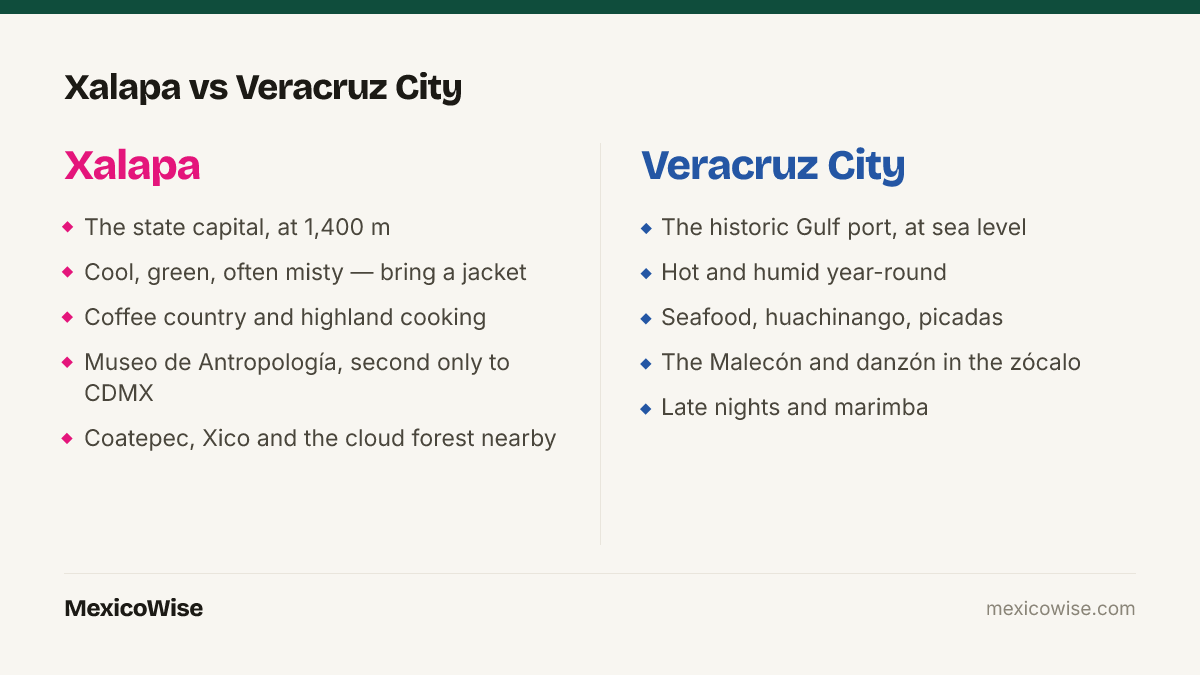
Both sit in the same state, roughly two hours apart on the highway, and they feel like different countries. Xalapa is the cool, green, university capital tucked into the cloud forest at around 1,400 meters. Veracruz City is the hot, loud, historic port down at sea level on the Gulf. Neither is “better.” The right base depends entirely on what you want your days to actually feel like, and getting that wrong is the difference between a great trip and one spent either sweating through your shirt or wishing you’d packed a jacket.
Here is the honest split before the detail: Xalapa for cool weather, coffee, and culture; Veracruz City for the sea, seafood, and nightlife. If your schedule allows it, do both. Two hours of ADO bus between them buys two genuinely different vacations.
| Xalapa | Veracruz City | |
|---|---|---|
| What it is | State capital, university town, cloud forest | The historic Gulf port |
| Altitude | About 1,400 m — cool, often misty | Sea level — hot and humid |
| Pack | A jacket and an umbrella | Shorts and nothing warm |
| Food | Coffee, highland cooking, Xalapeño beans | Seafood, huachinango, picadas |
| The set piece | Museo de Antropología — second only to CDMX | The Malecón, the zócalo, danzón at dusk |
| Evenings | Cafés, student bars, live music | Marimba in the plaza, late nightlife |
| Day trips | Cofre de Perote, Coatepec, Xico waterfalls | Antigua, Boca del Río, the reef |
| Best for | Cool air, culture, coffee | The sea, seafood, noise |
Weather: this is the real decider
This is where most people should make the call. Xalapa is cool, often overcast, and frequently drizzly year-round. The local word is chipi-chipi, the fine persistent mist that rolls in off the mountains and can hang around for days. Highs often sit in the low-to-mid 20s C, and evenings genuinely call for a light jacket. Some visitors find it moody and beautiful; others find it grey and damp. Both reactions are valid.
Veracruz City is the opposite in every way: hot and humid most of the year, with sticky, heavy highs in summer that can top 33 to 35 C with brutal humidity (approximate). The sea breeze helps on the malecón, and winter brings the norte, a strong cold north wind that can shut down the port for a day or two and actually makes the coast pleasant from December to February.
The friend’s-eye rule: ask yourself whether you would rather be warm or comfortable. If sweating ruins your day, base in Xalapa. If you came for the beach and want heat, the port is obvious. This one fault line decides more trips than food or culture ever will.
Food: two different plates
Xalapa is coffee country and it shows. The whole region around it grows and roasts, and café culture is woven into daily life; you order a lechero, coffee cut with steamed milk poured tableside, at places like Café Lindo or the old Café de la Parroquia tradition that the coast made famous. The city is also the namesake of the jalapeño (yes, from Xalapa), and its casual student food scene runs on antojitos, garnachas, and cheap, good, unpretentious eating.
Veracruz City is about the sea, full stop. This is the home of pescado a la veracruzana, whole fish in a tomato, olive, and caper sauce that traces straight back to the port’s Spanish and Caribbean history. Add mariscos of every kind, arroz a la tumbada (a soupy seafood rice), huachinango (red snapper), and cold beer at a shaded table in Boca del Río next door, where the seafood restaurants line the river mouth. If seafood is your priority, the port wins outright and it isn’t close.
- Cool-weather comfort food and coffee: Xalapa.
- Fresh Gulf seafood and the classic veracruzana plate: Veracruz City.
Culture vs energy
Xalapa punches far above its weight culturally. The Museo de Antropología de Xalapa (the MAX) is one of the best archaeology museums in the country, with a world-class collection of colossal Olmec heads and Gulf-coast pieces you cannot see assembled anywhere else. As the state capital and home to the Universidad Veracruzana, it also has a serious music and student scene, a state symphony, theater, and bookshops. It is the choice for slow, cerebral days.
Veracruz City trades museums for atmosphere and pure energy. The zócalo comes alive in the evenings with live danzón and son jarocho, the harp-and-jarana music of the region; the malecón fills with families and street vendors; and the nightlife runs late and loud. Carnival, usually in February or early March before Lent, is one of the oldest and biggest in Mexico, with parades, comparsas, and days of street celebration. For sensory, social, up-late travel, the port wins.
Day trips
From Xalapa, the cloud forest opens up. Coatepec and Xico are short trips for coffee tasting, waterfalls (the Cascada de Texolo near Xico is the postcard one), and pueblo mágico strolling. You can reach the archaeological zones of the Gulf coast and the coffee fincas of the sierra, and on a clear day the Cofre de Perote volcano looms over everything.
From Veracruz City, everything points to the water. The fortress of San Juan de Ulúa, once the port’s colonial defense and later a notorious prison, sits on a spit reachable in minutes. Boca del Río is the seafood-and-beach extension of the city, and the beaches and reef of the Sistema Arrecifal Veracruzano are right offshore. Cardel and the ruins of Cempoala (a Totonac city Cortés actually allied with) are an easy drive north.
Getting there and around
Both are on the ADO bus network, which runs frequent, comfortable buses between Xalapa’s CAXA terminal and Veracruz City in roughly two hours (approximate). ADO also connects both cities to Puebla and Mexico City, so you can chain them into a larger trip. Veracruz City has its own airport with more flights; Xalapa’s airport is smaller, so many people fly into Veracruz and bus up to the capital. Within each city, taxis and app rides are cheap and easy; you do not need a car for either.
The verdict
Base in Xalapa if you want cool, misty air, coffee, the MAX museum, and green cloud-forest day trips, and if heat genuinely wears you down. It is the pick for culture-first, slower travelers.
Base in Veracruz City if you want the Gulf, world-class seafood, live danzón in the plaza, and evening energy that runs late. It is the pick for beach, food, and nightlife.
Best of all, split it. A couple of days in the port for sun, seafood, and Carnival-style energy, then two hours up the highway to the cloud forest for coffee, museums, and cool nights. Same state, same short bus ride, two completely different trips.
More from Veracruz