Zihuatanejo vs Ixtapa: Where to Base on the Guerrero Coast
Published Jul 3, 2026 · updated Aug 29, 2026
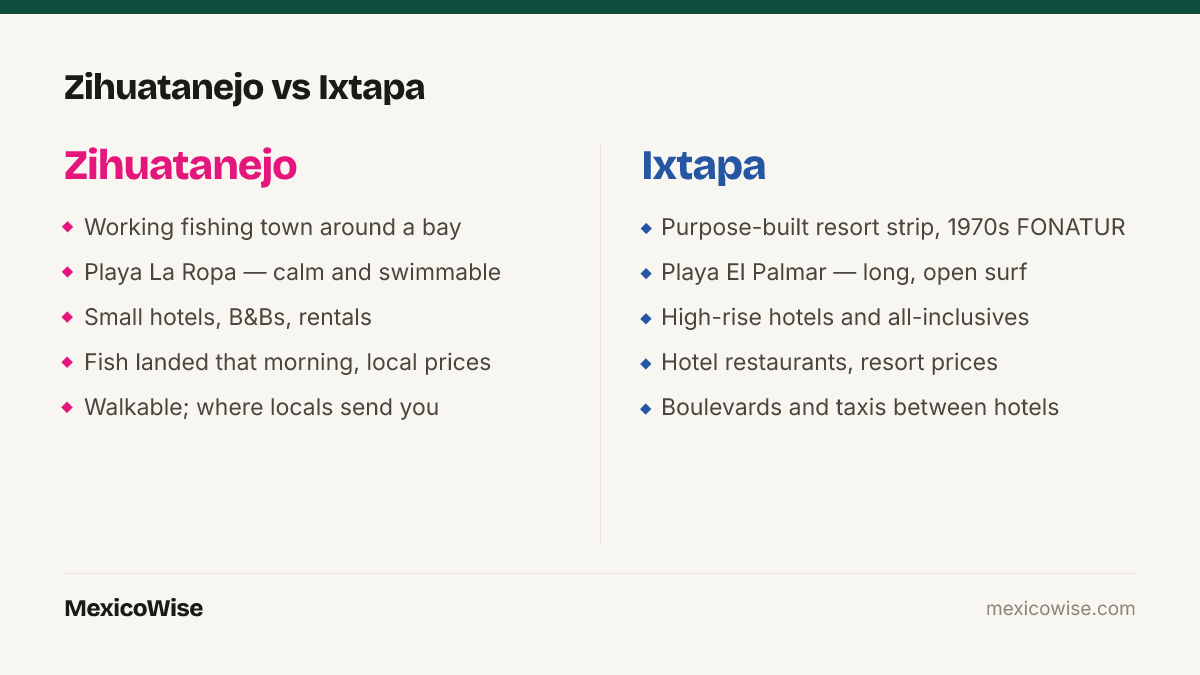
They share one airport (ZIH, the Ixtapa-Zihuatanejo International) and sit about a 10-minute drive apart, but they are two opposite ideas about what a beach trip should be. Zihuatanejo is an old fishing town wrapped around a working bay, the kind of place where the fleet still comes in at dawn and the fish you eat at lunch was in the water that morning. Ixtapa is a planned resort strip that FONATUR, the government tourism agency, laid out from scratch in the 1970s, the same playbook that built Cancún: wide boulevards, hotel towers in a row, one long beach engineered for package tourists.
Most people who know the area base in Zihua and treat Ixtapa as a day trip. Here is why, when the reverse makes sense, and how to think about the thing everyone quietly worries about first.
| Zihuatanejo | Ixtapa | |
|---|---|---|
| What it is | Working fishing town around a bay | Purpose-built resort strip (FONATUR, 1970s) |
| Airport | ZIH, shared — about 15 min away | ZIH, shared — about 20 min away |
| Best beach | Playa La Ropa — calm, swimmable | Playa El Palmar — long, open surf |
| Where you sleep | Small hotels, B&Bs, rentals | High-rise hotels and all-inclusives |
| Food | Fish landed that morning; local prices | Hotel restaurants; resort prices |
| Evenings | Waterfront paseo, small bars | Hotel bars, a couple of clubs |
| Getting around | Walkable | Boulevard walking, taxis between hotels |
| Best for | Couples, food, character, repeat visitors | All-inclusive packages, families wanting a pool complex |
The security question, straight
Let’s answer the anxious question early, because it is the reason half of you are reading. Guerrero is a state that carries real security concerns, and the headlines are not imaginary. The honest read: the tourist corridor of Zihuatanejo and Ixtapa has long run as a relatively calm pocket, and the trouble that makes the news is generally tied to other parts of the state, inland municipalities and highway routes, and to organized crime settling scores, not to tourists on Playa La Ropa.
The single biggest lever you control is how you arrive. Flying into ZIH and staying inside the beach-town routine is a very different risk profile than driving the highways that thread through the sierra. The old coastal road toward Acapulco and the mountain routes toward Chilpancingo are not casual road-trip material right now.
What a friend who lives here would tell you: fly in, don’t do long overland drives around Guerrero, keep to the bay and the resort strip, and you will very likely never sense any of it. Take taxis at night rather than wandering solo well outside the tourist core, the same common sense you’d use in any city. Don’t go looking for nightlife in neighborhoods no visitor has a reason to be in. That’s the whole discipline.
Zihuatanejo: the town with a pulse
Zihua has what Ixtapa was never designed to have: a real center. There is a working malecón (the Paseo del Pescador), a Sunday-evening basketball court that doubles as the town’s living room, market stalls, a fish market, and streets that go somewhere other than the next hotel lobby.
The bay is ringed by four main beaches, each with a different personality:
- Playa La Ropa — the headline swimming beach on the south side of the bay. Calm, gently sloping water, a line of beach restaurants where you can spend the whole day. This is where you actually want to swim.
- Playa Las Gatas — reachable by a short panga (water taxi) ride from the main pier for roughly 60–80 MXN round trip, approximate. A protective rock breakwater keeps the water flat, so it’s the best snorkeling and the safest for small kids.
- Playa La Madera — a short walk from downtown, a middle ground between town noise and La Ropa’s calm, with good mid-range places to stay above it.
- Playa Principal — the town beach, where the fishing fleet ties up. Not for swimming, but the heart of the working town.
For eating, this is where Zihua leaves Ixtapa behind. Look for grilled fish and the local tiritas (thin strips of raw fish cured in lime and chile, Zihua’s answer to ceviche) at the palapa restaurants on La Ropa. La Sirena Gorda near the pier is a long-running spot for seafood. The downtown streets around Cuauhtémoc give you taquerías, torterías, and paleta shops at prices no beachfront resort will match. You can eat extremely well here for a fraction of an Ixtapa dinner.
Base here if you want a town rather than a compound, you like paying local prices for grilled fish with your feet in the sand, and you want your evenings to involve walking somewhere with a pulse.
Ixtapa: the easy resort strip
Ixtapa is essentially one address: Playa El Palmar, a long straight beach backed by a wall of big hotels along Boulevard Ixtapa. Everything is walkable in the sense that it’s all in a row, and there are no decisions to make, which for some trips is exactly the point.
A few honest notes on the strip:
- The water is more open ocean. El Palmar faces out, so surf and undertow can be stronger than the sheltered bay in Zihua. There are days the flags are up and swimming is real work, especially with kids. La Ropa’s gentle water is genuinely better for actual swimming.
- It’s tidy in a manufactured way. Clean, safe-feeling, quiet at night, and a little characterless. You trade soul for predictability.
- Beyond the strip there’s Marina Ixtapa with its restaurants and a boat launch, and Playa Linda a bit further north, where pangas run out to Isla Ixtapa (Isla Grande). The island has calm snorkeling coves like Playa Cuachalalate and is the one Ixtapa-side day trip worth building around.
- The golf, the marina, and the string of all-inclusives (the big chains cluster here) are the real draw. If a pool, a kids’ club, and a swim-up bar are the vacation, Ixtapa delivers it without friction.
Base here if you want a self-contained all-inclusive, you’re traveling with a group that wants zero logistics, or you simply don’t want to think.
Getting between them, and getting around
The two are joined by a short, cheap taxi ride, roughly 150–250 MXN one way, approximate, depending on time of day and your haggling. Combis (shared vans) also run the route for a handful of pesos if you’re patient. From ZIH airport, a taxi into Zihua or Ixtapa runs somewhere around 250–400 MXN, approximate.
For getting to the region itself, most visitors fly, and that’s the recommendation given the security note above. If you are coming overland from Mexico City, first-class bus lines like ETN and the Estrella de Oro / Costa Line network serve the Zihuatanejo terminal, but it’s a long haul (on the order of 8–9 hours, approximate) and not something to romanticize on these particular roads. Flying is the friend’s advice here.
Festivals and timing
Time your trip around a couple of things if you can. Semana Santa (Easter week, March or April) is peak Mexican-tourist season, when both towns fill and prices jump. The Zihuatanejo International Guitar Festival lands in the winter high season, usually around March, and turns La Ropa’s restaurants into small stages. Día de la Marina (Navy Day, June 1) is a local event in a genuine fishing town, not a manufactured one. High season generally runs roughly December through April, dry and warm; the summer and early fall are cheaper, greener, and carry the Pacific rain and hurricane-season risk.
Who should pick which
- Families with young kids — this splits. Ixtapa wins on resort infrastructure, kids’ clubs, and one-stop logistics, but the safest swimming water is on the Zihua side at Las Gatas and La Ropa. A family that wants an all-inclusive should stay Ixtapa and taxi over to swim; a family that wants to actually be in the water all day should base in Zihua.
- Couples and independent travelers — Zihuatanejo, easily. More to walk to, far better food, actual evenings, and lodging with character above Playa La Madera.
- Budget travelers — Zihuatanejo, no contest. Modest guesthouses in town, taquerías, and beach-palapa lunches cost a fraction of an Ixtapa package.
- Zero-planning, all-inclusive vacation — Ixtapa.
- Snorkeling and boat days — a tie, and a reason to do both: Las Gatas from the Zihua pier, Isla Ixtapa from Playa Linda.
The verdict
Base in Zihuatanejo. It has the character, the better casual food, the walkable evenings, and beaches (La Ropa, Las Gatas, La Madera) that are as good or better than the strip’s single stretch of open-ocean sand. Ixtapa’s Playa El Palmar and a full resort day are a cheap taxi ride away whenever you want them.
Only flip this if you specifically want an all-inclusive you never plan to leave, or you’re wrangling a group that would rather trade Zihua’s texture for the strip’s frictionlessness. For almost everyone else, sleep in the fishing town and visit the resort, not the other way around.
More from Guerrero